
How to practise flamenco with videos
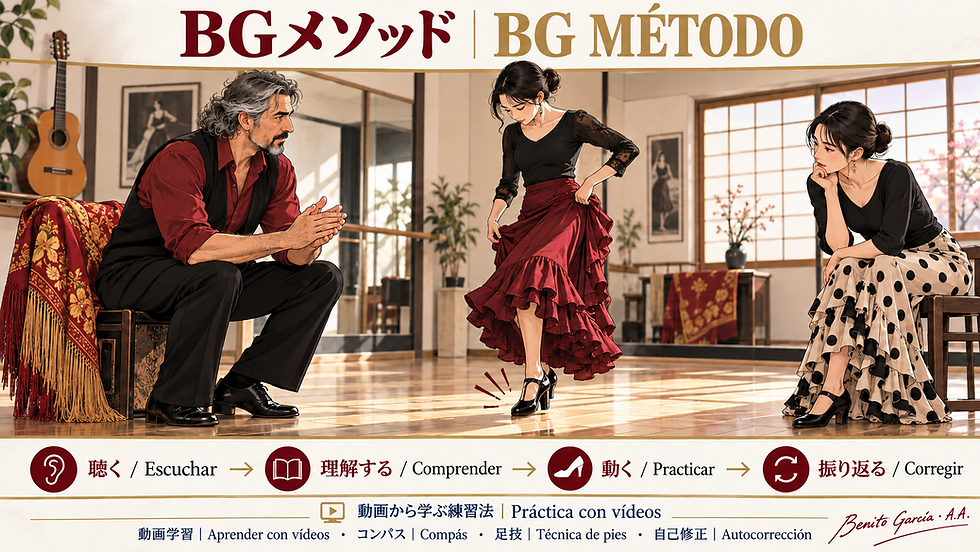
A video can help us learn a sequence. Remembering the steps, however, does not always tell us when to use them in the music. To bring what we observe into our own dancing, we need to listen, understand what is happening and choose what to practise.
This article brings together ideas from the video archive of Benito García at BG Flamenco. It is an editorial synthesis based on documented analyses of four videos, rather than a word-for-word transcript. The reference videos are linked at the end.
Watch with a question
Before you start, decide what you want to understand. It might be the end of a sung phrase, a llamada or a moment when the dancer waits. A specific question helps you direct your eyes and ears when many things are happening at once.
Follow more than the feet. Observe the dancer’s expression and how the singing, guitar and other participants respond. Movement gains meaning within that relationship. Then try to describe what you noticed in simple words and check it when you watch again.
Listen before deciding
In bulerías, a few familiar marcajes can be a starting point. A marcaje is a movement that supports and accompanies the music. Listen to the length of the singing to decide whether to wait or continue, rather than imposing a fixed sequence of steps.
Look for the relationship between cues in the singing, the llamada, pauses and the remate. A llamada prepares or announces a development; a remate closes a musical or movement phrase. Hearing their relationship helps you understand when to enter, sustain and close.
Distinguish speed from rhythmic character, too. Alegrías and bulerías differ in more than how fast they go. Listen to their accents and the way the rhythm moves forward, without making speed your only reference.
Separate the footwork sounds
When studying zapateado, separate planta, tacón and golpe. Planta uses the front of the sole; tacón uses the heel; golpe uses the whole sole. These are different contacts and sounds, and we need to hear them clearly.
Practise with one foot and then the other, at a speed that lets you distinguish each sound and keep your body stable. Before accelerating, check whether the sounds remain separate and whether you maintain your support. Matching the video’s speed cannot replace that check.
Slow movement still needs expression
An escobilla—the section of a dance focused on footwork—is not necessarily easier because it is slow. The rhythm needs to leave room for expression. When watching soleá, notice how the intention of the movement is sustained and how the transition makes sense with the accompaniment.
Ask not only how much the speed increases, but whether the development retains musical and expressive meaning. Observe what allows the accompanying musicians to understand what comes next. This connects the study of technique, expression and musical communication.
Choose the right support for practice
A performance video may contain many cues and changes of speed. It is valuable for observing expression and interaction between performers, but it can be difficult to use as your only foundation for learning compás: the rhythmic flow shared by music and dance.
To work on compás, also use a metronome, palmas and shared practice. Each has a role. Video lets you observe a moment again; clapping and practising with someone else lets you check how you sustain the rhythm together.
A suggestion for your next practice
The following sequence is an editorial suggestion for applying these ideas; it does not reproduce an exercise dictated word for word in the videos. Choose a short passage and one question. Listen for the musical cue that interests you and observe what the dancer does in relation to it.
Then try a part you can already perform: a familiar marcaje or a short footwork sequence. If you are studying sounds, separate the feet and look for clarity and stability. If you are studying an entrance, check the relationship between your movement and the musical cue.
Listen again and change one specific aspect. Ask yourself: what did I hear, why did I start here, and are the sounds distinct? The aim is to understand a choice in your dancing and be able to review it, beyond remembering the order of the steps.
If a cue is still unclear, bring your chosen passage to class. Video provides a reference; accompanied practice lets you check what you have understood.

Comments